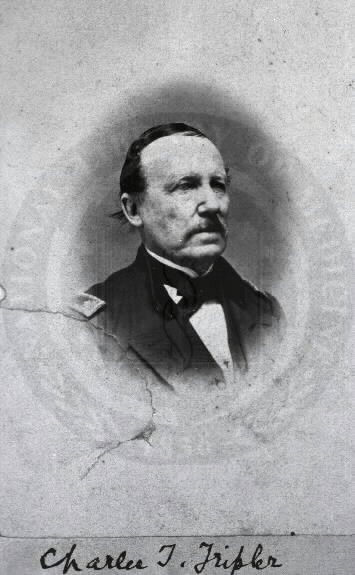
Dr. Charles S. Tripler
Go here for a copy of the "Handbook for the Military Surgeon," by Dr. Tripler
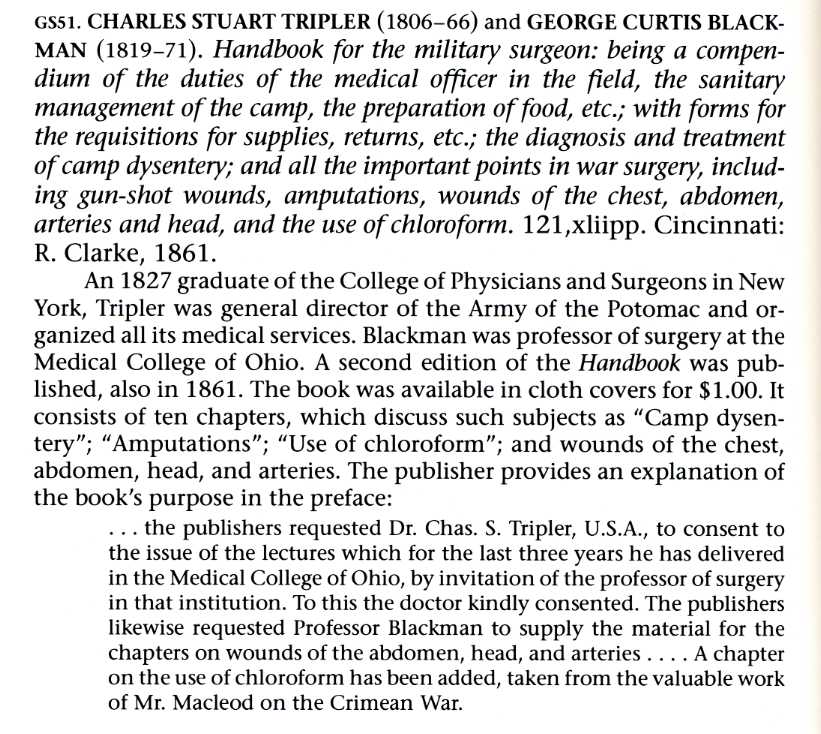
Handbook for the military surgeon
Information from Rutkow: History of Medicine, p. 44
On June 26, 1920, the Department Hospital, Territory of Hawaii, was redesignated Tripler Army Hospital in honor of Charles Stuart Tripler, Brig. Gen. MD., U.S. Army Medical Department.
It may seem unusual to honor a man who's career seemed outwardly uneventful. During his lifetime he was never publicly recognized for his contributions to military medicine.
This 19th century medical department officer, veteran of three wars and author of one of the most widely read manuals in Army medical history, the "Manual of the Medical Officer of the Army of the United States," has left a legacy of his works that still serve as an inspiration to the current operations at Tripler.
It was only after his death, following repeated petitions friends and Tripler's wife that President Andrew Johnson promoted Tripler to a brigadier general. The orders, signed by Johnson, on March 7, 1867, gave the date-of-rank as March 13, 1865. Charles Stuart Tripler was born Jan. 19, 1806, in New York City. He graduated from the College of Physicians and Surgeons in New York in 1827 and served in the city's Bellevue Hospital. He entered the Army at West Point, New York, and received a commission as an assistant surgeon in 1830.
rmy medical practice of the time was crude and rudimentary. There was no system to remove the wounded from the field of battle at the time and sanitation measures were ineffective. But due to Tripler's perseverance, many of these hazards were corrected.
In 1835, Tripler saw his first combat action in the Florida Seminole War. After three years in Florida, he was sent to Detroit Barracks, Mich., where he married Eunice Hunt on March 2, 1841. In 1846, Tripler, then an Army surgeon, was made medical director of a regular troop division during Gen. Winfield Scott's advance against Mexico City in the Mexican War. He was reassigned to New Orleans in 1848.
Four years later, he accompanied troops to the West Coast via Panama on a harrowing journey in which he cared for men plagued with cholera, malaria and dysentery. Upon returning East for Duty at Newport Barracks, KY., in 1858, Tripler wrote and published his famous "Manual of the Medical Officer of the Army of the United States."
Prior to publication of his manual, the pages of another Tripler-authored book rolled off the presses of the printing firm of Wrightson and Company, New York City, and received a drab brown cover stamped in gold lettering.
This manual was to become the bible of countless thousands of medical officers who followed Tripler by standardizing the physical requirements for Army recruits. He may have never known it, but his publications were widely read by a majority of the Army physicians of that era.
In 1861, Tripler wrote, "Handbook for the Military Surgeon," with Dr. George C. Blackman. He received $350 for the first 750 copies of the manual from the War Department. He intended to revise the book but failed to have the original copyrighted before he died.
Tripler's two manuals may have seemed inconspicuous at first, but he was attempting to standardize many of the Army's medical practices.
Also in 1860, at the beginning of the Civil War, Tripler became the first medical director of the Army of the Potomac. He was with Union General McClellan during the bloody peninsular campaign, ending with a series of Battles of the Seven Days before Richmond. While Confederate General Robert E. Lee still controlled the South's capital, Tripler was ordered to Detroit as chief surgeon of the Department of the Lakes.
Tripler died Oct. 20, 1866, in Cincinnati, and was buried with military honors in Detroit. His grave was later marked by a monument erected by subscription from Medical Corps officers.
________________
CHARLES STUART TRIPLER*
Medical Corps
(19 January 1806-20 October 1866)
CHARLES STUART TRIPLER (January 19, 1806-October 20, 1866), Brevet Brigadier General, U. S. Army, a distinguished member of the medical corps, was born on the "Bowery" in New York City. His father, whose name has not come down to us, was a merchant of English decent. His mother was a daughter of Hugh Stuart, formerly governor of Bermuda. On account of reverses in his father’s business Charles was apprenticed while still a small boy, to an apothecary, Dr. Stephen Brown, who was also a graduate in medicine. He was given a good practical education in his off hours and in 1823 began the study of medicine in the College of Physicians and Surgeons where he was graduated in 1827. Then followed a period of service as resident physician at Bellevue Hospital, during which he went through an epidemic of smallpox and contracted the disease himself. About this time he was offered a position with the East India Company, but, with an eye already upon the army medical service, he declined. He went instead to West Point where he entered the family of Surgeon Walter V. Wheaton, assisting him,. in his post duties and in some private practice. He made many friends among the officers of the garrison and, being a keen student, was permitted to take the courses in mathematics and languages with the cadet classes. While thus engaged he obtained permission to take the examination for the medical service and was commissioned as an assistant surgeon on October 30, 1830. His first stations were Houlton and Eastport in Maine on the New Brunswick border. Then, after a period of field duty in the Red River country of Louisiana, he went to Baton Rouge Barracks for station. Following the outbreak of the Seminole War in December 1835, he was sent to Florida early in the following year where for three years he saw much field duty against the elusive Indians of that state.
In 1839 he was. sent to duty at Buffalo Barracks, N. Y., and in January 1840 to Detroit Barracks, Mich. Here on March 2, 1841, he was married to Eunice Hunt, daughter of Captain Thomas Hunt, a former army officer, but at this time serving as Register of the Land Office in Detroit. He was still at Detroit
______________________________
Charles Stuart Tripler*
Medical Corps
(19 January 1806-20 October 1866)
CHARLES STUART TRIPLER (January 19, 1806-October 20, 1866), Brevet Brigadier General, U. S. Army, a distinguished member of the medical corps, was born on the "Bowery" in New York City. His father, whose name has not come down to us, was a merchant of English decent. His mother was a daughter of Hugh Stuart, formerly governor of Bermuda. On account of reverses in his father’s business Charles was apprenticed while still a small boy, to an apothecary, Dr. Stephen Brown, who was also a graduate in medicine. He was given a good practical education in his off hours and in 1823 began the study of medicine in the College of Physicians and Surgeons where he was graduated in 1827. Then followed a period of service as resident physician at Bellevue Hospital, during which he went through an epidemic of smallpox and contracted the disease himself. About this time he was offered a position with the East India Company, but, with an eye already upon the army medical service, he declined. He went instead to West Point where he entered the family of Surgeon Walter V. Wheaton, assisting him,. in his post duties and in some private practice. He made many friends among the officers of the garrison and, being a keen student, was permitted to take the courses in mathematics and languages with the cadet classes. While thus engaged he obtained permission to take the examination for the medical service and was commissioned as an assistant surgeon on October 30, 1830. His first stations were Houlton and Eastport in Maine on the New Brunswick border. Then, after a period of field duty in the Red River country of Louisiana, he went to Baton Rouge Barracks for station. Following the outbreak of the Seminole War in December 1835, he was sent to Florida early in the following year where for three years he saw much field duty against the elusive Indians of that state.
In 1839 he was. sent to duty at Buffalo Barracks, N. Y., and in January 1840 to Detroit Barracks, Mich. Here on March 2, 1841, he was married to Eunice Hunt, daughter of Captain Thomas Hunt, a former army officer, but at this time serving as Register of the Land Office in Detroit. He was still at Detroit when, in May 1846, the Mexican War began on the Rio Grande. He accompanied the Detroit garrison under Colonel Bennett Riley to Newport Barracks, Ky., and thence by way of the Ohio and Mississippi rivers to New Orleans. The army of General Scott was assembled at Lobos Island, sixty miles south of Tampico, Mexico, in the latter part of February 1847, and early in March effected a landing at Sacrificios, near Vera Cruz, and laid siege to that city, which capitulated near the end of the month. In the organization of the army, Tripler, who had been advanced to the grade of surgeon on July 7, 1838, was assigned as medical director of General Twigg’s division of regular troops. In that capacity he participated in the battles incident, to the march to Mexico City—Cerro Gordo, Contreras, Churubusco, Molino del Rey, and Chapultepec. General Twigg in his reports speaks in ‘high praise of the devoted service of Tripler and his assistants during these battles. Tripler, however, in reporting upon the health of the army from Puebla, under date of July 6, 1847, cites the factors which were responsible for the scourge of fevers, diarrhoeas, and dysentery which had struck the troops. He gave first place to the inferior physical stamina of the men who had been recruited for the war, with the influences of climate, uncleanliness, deficiencies in clothing and shelter, and the use of native foods as important though secondary factors. Upon the capture of Mexico City on September 14, each division established its own hospital which operated until December, when Tripler was assigned by the newly appointed Medical Director Satterlee to the duty of organizing and operating a general hospital for the army. For this purpose he was given the Bishop’s palace, the Governor's palace, the Iturbide palace, the Inquisition, the College of Mines, and the convent of Santa Isabella. Much difficulty was experienced in its operation on account of the wide dispersion of the buildings, the shortage of medical officers, and the inferior quality of the personnel obtainable for the service of the hospital. On the whole, its administration by Tripler was decidedly creditable. March 5, 1848, brought the armistice, and in April the patients from the general hospitals in Mexico City and Puebla were sent to Jalapa under charge of Tripler and Surgeon P. H. Craig, and in May they were transferred to New Orleans under the care of Craig. The war ended, Tripler returned to his post at Detroit Barracks, where he served until 1850, when the post was abandoned and he was transferred to Fort Gratiot, Michigan, near the outlet of Lake Huron. Shortly before leaving Detroit he was sent as a delegate by the Michigan State Medical Society to the annual meeting of the American Medical Association in Cincinnati in May 1850. Surgeon General Lawson took advantage of the opportunity and appointed him to represent the Medical Department of the Army at the meeting. This was the first occasion when the army was represented at the meetings of the national society. In June 1852 he was ordered to New York to accompany troops to the west coast by way of Panama. The trip across the isthmus was by boat up the Chagres river as far as possible and then on overland march to the City of Panama. Cholera, malaria, diarrhoea, and dysentery caused terrific morbidity and many deaths. Tripler, the only medical attendant, had an experience passing anything that he had ever before gone through. It was not until two years later that the Panama railroad was put through. In California he served two years in San Francisco where he engaged in, a flourishing private practice which helped in those boom days of extortionate prices. Two more years at Benicia Barracks and he returned east by way of Panama to join his wife and family whom he had left in Detroit. In April 1856 he took station at Newport Barracks, Ky., across the Ohio from Cincinnati. This post was at the time the recruit depot for all the western country. The issues which later brought on the Civil War were already agitating the country and the garrison at Newport was divided as was the country at large. Every interest and sentiment drew Tripler toward the Northern cause. With rumors of strife in the air and haying in mind the experience of the Mexican War, he prepared his Manual of the Medical Officer of the Army of the United States, published in Cincinnati in 1858. Apparently the first of a projected series, this volume is devoted entirely to the subject of recruiting, the physical requirements, and the physical examination of the recruit. Immediately upon its appearance Tripler’s book was accepted throughout the army as the authoritative last word on recruit requirements. This effect was heightened when in 1866 a second edition was issued from the Government Printing Office. In 1884 an Epitome of Tripler’s Manual, edited by Major Charles R. Greenleaf, was published as a Government document.